Home/Services/Automatic Transfer Switch (ATS) Installation
Backup Power Engineering
Stand By Generator Installation: Automatic Transfer Switch (ATS) Installation
Precision electrical transfer switches that isolate municipal power lines and seamlessly connect generator backup to prevent hazardous grid backfeeding.
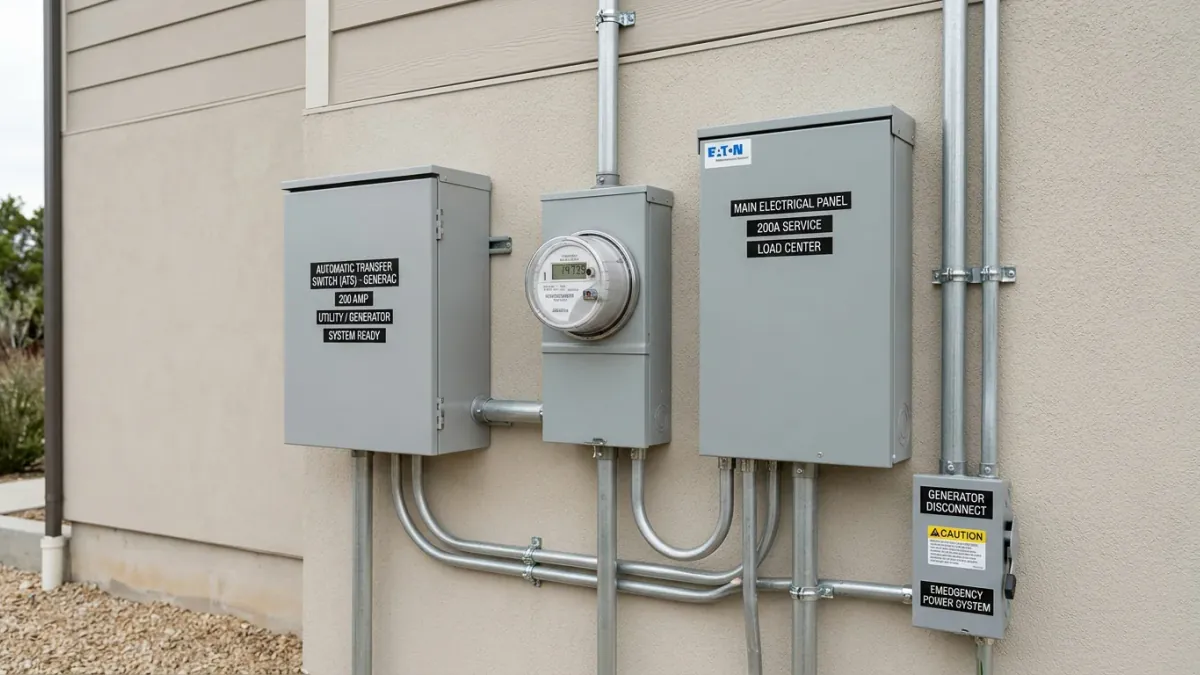
An automatic transfer switch acts as the intelligent nerve center of any standby generator system. The switch continuously evaluates incoming utility line power, detecting voltage drops, frequency irregularities, and complete service outages. Within seconds of an interruption, internal mechanical interlocks disconnect the utility feed and close the generator contacts, eliminating dangerous electrical backfeed that could endanger utility line workers. Qualified electricians wire service-entrance-rated switches between your utility meter and distribution board, ensuring proper neutral-ground bonding and code-compliant conductor sizing.
An automatic transfer switch provides a break-before-make mechanical barrier isolating utility power lines from on-site generator feeds. Installing service-entrance-rated switches requires precise neutral-ground bonding adjustments at the primary disconnect to satisfy National Electrical Code Article 702 and prevent dangerous stray ground currents.
✓Service-entrance-rated NEMA 3R outdoor enclosure installations
✓Low-voltage utility sensing circuit and control wire routing
✓Proper neutral-ground separation for downstream distribution panels
✓Digital load management and intelligent circuit shedding integration
Standard Installation Workflow
1
Service Disconnect Audit
Verifying utility meter disconnect capacity, service entrance amps, and bus bar bonding.
2
Enclosure Placement
Mounting the NEMA 3R weather-resistant switch directly adjacent to the meter base or main breaker.
3
High-Amperage Wiring
Pulling heavy-gauge copper feeders and low-voltage twisted-pair sensing wires in separate conduit.
4
Interlock Verification
Testing mechanical and electrical interlocks under simulated outage conditions to confirm safety.
Frequently Asked Questions Regarding Automatic Transfer Switch (ATS) Installation
The automatic transfer switch acts as a double-throw safety barrier between municipal utility lines and your generator. The moment utility voltage collapses, the switch mechanically disconnects from the grid before connecting to the generator, preventing catastrophic backfeeding into neighborhood utility lines.
A service-entrance-rated transfer switch installs directly between your utility electrical meter and the existing main distribution panel. The switch acts as the primary service disconnect for the property, eliminating the need to tear out or replace your existing indoor breaker panelboard.
Modern transfer switches feature NEMA 3R weather-resistant aluminum or powder-coated steel enclosures rated for direct outdoor rain, snow, and extreme temperature exposure. Mounting the switch outdoors adjacent to the electric meter minimizes high-amperage cable runs between the utility drop and the generator.
Low-voltage two-wire control wiring and utility sensing circuits run inside dedicated conduit between the switch and the generator control board. The switch continuously reports utility phase voltage, signaling the generator engine controller to crank the second utility line voltage sags below 80%.
National Electrical Code mandates that neutral and ground conductors be bonded at only one location—the first service disconnect. If a service-entrance transfer switch is installed, the bonding jumper sits inside the switch, requiring neutral and ground to remain completely separated inside the downstream breaker panel.
The transfer switch observes restored utility power for a preset stabilization period, usually five minutes, ensuring grid voltage is steady and clear of surges. Once verified, the switch transfers building loads back to the utility feed and allows the generator engine to run unloaded for a cooldown cycle.
Both configurations provide mechanical interlocks that eliminate electrical backfeeding when installed correctly. Automatic switches provide superior protection because they switch power instantly without requiring homeowners to navigate dark basements or operate heavy breakers in hazardous storm conditions.
Residential transfer switches are sized to match the property's incoming utility service, predominantly 100-amp, 200-amp, or 400-amp configurations. Installing an undersized 100-amp switch on a 200-amp service violates electrical code and causes dangerous thermal overloads across the main bus.
Ready for Backup Power?
Automatic Transfer Switch (ATS) Installation
Speak with our electrical coordination team to discuss kilowatt sizing, transfer switch ratings, and current equipment availability.