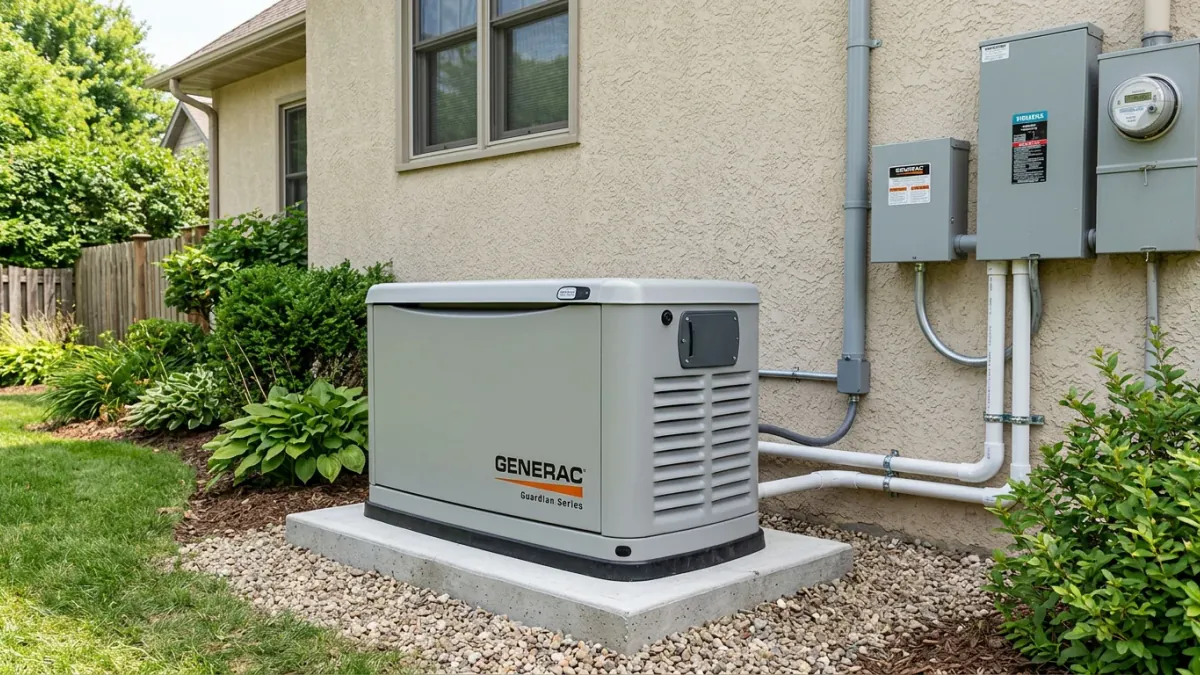
Stand By Generator Installation: Whole-House Standby Generator Installation
Permanently installed residential backup generators that automatically restore household electricity within seconds during utility grid outages and severe weather events.
Whole-house standby systems protect your home from sudden blackouts by continuously monitoring utility line voltage. When grid electricity fails, the generator engine starts automatically, and the transfer switch routes emergency power to your main breaker panel. Our electrical specialists calculate your exact starting and running wattages to ensure central air conditioners, well pumps, refrigeration, and medical devices operate seamlessly. Each installation includes code-compliant placement, structural composite mounting pad leveling, and turnkey coordination with municipal permitting authorities to ensure safe, enduring performance under extreme weather conditions.
Residential whole-home power systems must absorb high motor starting spikes—known as Locked Rotor Amperage (LRA)—from central air conditioning compressors, well pumps, and refrigeration without dropping voltage. Sizing calculations account for both steady continuous wattage and momentary inrush currents, ensuring the alternator never stalls during unexpected utility failures. Transition occurs automatically within ten to twelve seconds, isolating the municipal grid and powering your main breaker panel seamlessly.
✓Exact continuous wattage and motor inrush load calculations
✓Level composite mounting pad installation with ground compaction
✓Automatic transfer switch integration directly into main electrical service
✓Pre-delivery municipal permitting and setback compliance verification
✓Comprehensive simulated power outage load testing upon commissioning
Standard Installation Workflow
1
Comprehensive Load Audit
Evaluating household electrical demands, HVAC motor inrush spikes, and utility service capacity.
2
Code & Setback Verification
Positioning the outdoor unit to satisfy NFPA clearance requirements and local property boundaries.
3
Switchgear & Feeder Wiring
Installing a service-entrance-rated transfer switch and heavy-gauge copper generator conductors.
4
System Commissioning
Simulating a sudden grid blackout to verify automatic transfer timing and load pickup stability.
Most residential homes ranging from 2,000 to 3,500 square feet operate comfortably on a 20kW to 26kW air-cooled generator. Calculating exact demand requires adding the running wattage of all continuous baseline circuits to the starting surges of major motors like heat pumps, central A/C compressors, and well pumps.
Utility power drops out completely for roughly ten seconds while the engine cranks and stabilizes at 3,600 RPM. Sensitive electronics like desktop computers will shut down unless protected by an uninterruptible power supply, while modern televisions and appliances tolerate the brief momentary pause without damage.
Running dual air conditioning compressors simultaneously often overloads standard residential generators unless load-shedding modules or electronic soft-start devices are wired into the compressor circuits. Soft starters lower motor inrush current by up to 65%, allowing a 22kW generator to handle both units without stalling.
National Fire Protection Association guidelines require generators to sit at least five feet from operable windows, exterior doors, and vinyl wall cladding unless the manufacturer certifies closer clearances. Local municipal setback codes often dictate greater distances, commonly between five and ten feet from neighboring property borders.
Modern residential units install cleanly on composite polymer pads engineered with crushed gravel underneath, provided the ground is fully compacted and level. Areas prone to soil shifting, flooding, or severe freeze-thaw cycles frequently mandate a four-inch poured concrete slab reinforced with rebar for maximum structural stability.
Electronic engine controllers initiate an automatic exercise cycle weekly or bi-weekly at a scheduled time. The generator starts, runs at reduced RPM for five to twelve minutes to circulate synthetic oil and charge the battery, and then shuts down without switching electrical loads from utility power.
Continuous runtime on natural gas depends purely on gas utility pipeline pressure, allowing units to operate for weeks during regional disasters. Propane installations depend on on-site storage capacity, where a standard 500-gallon tank running at half-load typically delivers seven to ten days of uninterrupted electrical power.
Professional electrical installation completed according to National Electrical Code standards protects existing electrical equipment warranties. Isolating the home via an approved automatic transfer switch prevents utility grid surges and utility transformer backfeeds from reaching home wiring when power is restored.
Ready for Backup Power?
Whole-House Standby Generator Installation
Speak with our electrical coordination team to discuss kilowatt sizing, transfer switch ratings, and current equipment availability.